LagosPortugalGuide.com
The best independent guide to Lagos
LagosPortugalGuide.com
The best independent guide to Lagos
Lagos, Portugal: an independent travel guide for 2026
Of all the towns along the Algarve, this is the one I would choose. Give me a single week of southern sunshine and one place to spend it, and I would not hesitate. Lagos, every time.
What I love about Lagos is that it has never settled into being one kind of town. It is a working Portuguese city of 31,000 people, a historic port that once sent Henry the Navigator's captains out to map the unknown, and a modern holiday town that hums with life. The old quarter holds the gilded Baroque interior of the Igreja de Santo António and the sobering former slave market. Yet walk down to the marina after dark and the lanes are loud with live music and beach bars, a wave of surfers and remote workers having settled here for the climate and the Atlantic swell. The energy runs right through the year.
For all that buzz, it is the coastline which is the most memorable. Meia Praia runs for almost 2km of golden sand to the east, while to the south the headland of the Ponta da Piedade hides a string of sheltered coves, among them Praia Dona Ana and Praia do Camilo, two of the finest beaches in Europe. Best seen from the water, the carved cliffs and grottoes are reason enough for the boat trip I recommend to every first-time visitor. The open Atlantic beaches draw surfers all year, and Lagos is one of the best places in Portugal to take a first lesson. It is an ideal base, too, for Sagres, Silves and the family parks at Slide & Splash and Zoomarine, none of them needing a car.
My wife is Portuguese, and between us we have spent more than twenty years getting to know this coast, in every mood from the August crush to a quiet January morning on Meia Praia. We have brought friends, family and visiting parents here and watched what works for each of them. This guide passes that on: where to stay, when to come, which beaches are worth the walk, and how to see the best of Lagos and the western Algarve beyond it.
My highlights of Lagos
The historic quarter
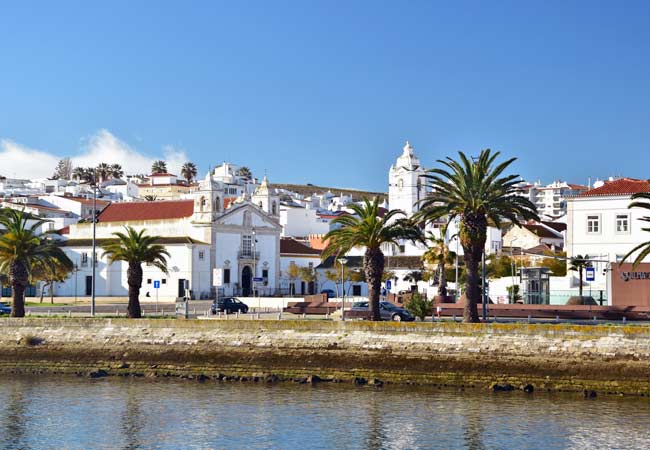
Spend a morning getting lost in the cobbled lanes of the old town and you will uncover five centuries of history in a single walk. The gilded Baroque interior of the Igreja de Santo António is one of the finest in Portugal, the former slave market sits as a sobering reminder of the darker side of the Age of Discovery, and the Forte da Bandeira still stands guard over the harbour mouth as it has since the 17th century.
Ponta da Piedade
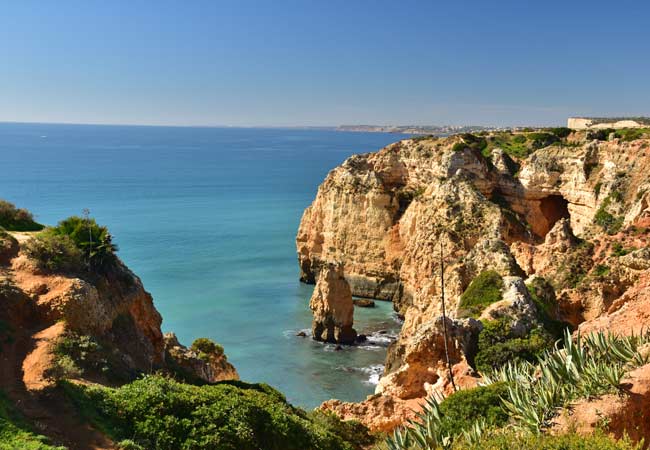
This is the Algarve at its most raw and spectacular, and in my view the single most beautiful stretch of coastline in southern Portugal. Towering cliffs, natural sea arches and hidden grottoes have been carved from golden limestone over millennia, and you can experience it in two ways: walk the clifftop trails for the sweeping views, or take a boat tour from the marina to slip inside the caves themselves. I would urge you to do both.
Praia de Dona Ana
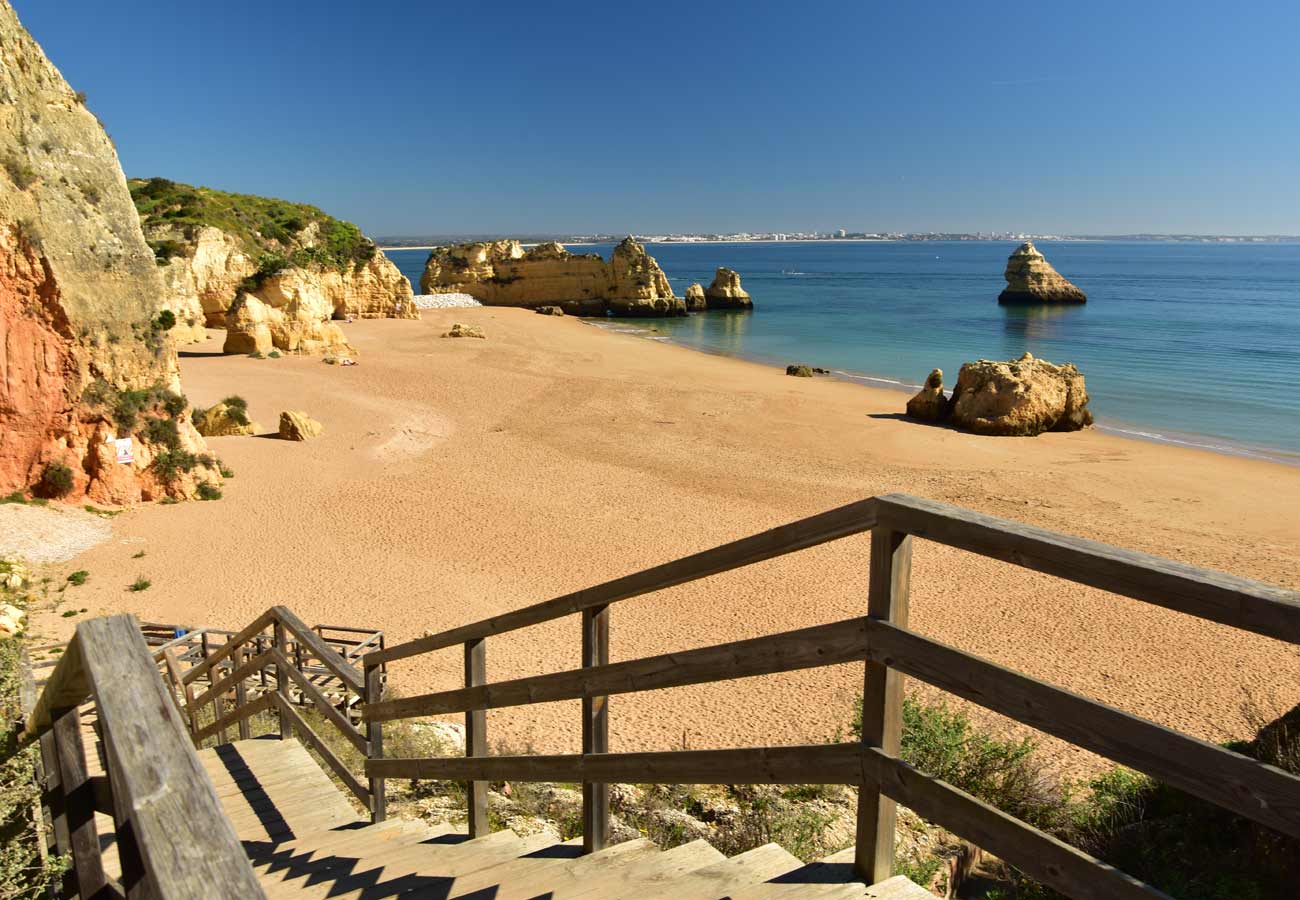
Soft golden sands, calm turquoise waters, and a backdrop of the Ponta da Piedade's limestone cliffs. There is a reason this beach is consistently ranked among the finest in Europe, and on a quiet June morning before the crowds arrive, you will understand it within a minute of stepping onto the sand.
Why visit Lagos for your holiday?
Lagos is the largest city in the western Algarve, with a permanent population of 31,000 that almost doubles during the summer months. The city sits along the Bensafrim estuary, at the meeting point of two very different coastal landscapes: the dramatic limestone headland of the Ponta da Piedade to the south, and the sweeping sand dunes of the Rio Alvor nature reserve to the east.
This contrast is what makes Lagos such an exceptional beach destination. The headland shelters a string of idyllic cove beaches that are calm, safe and ideal for families, while a short walk in the other direction brings you to Porto de Mós, where Atlantic waves draw surfers year-round. In between runs the Meia Praia, almost 2km of open golden sand stretching along the eastern shoreline. Few Algarve towns give you this much variety within a 15-minute drive of your hotel.
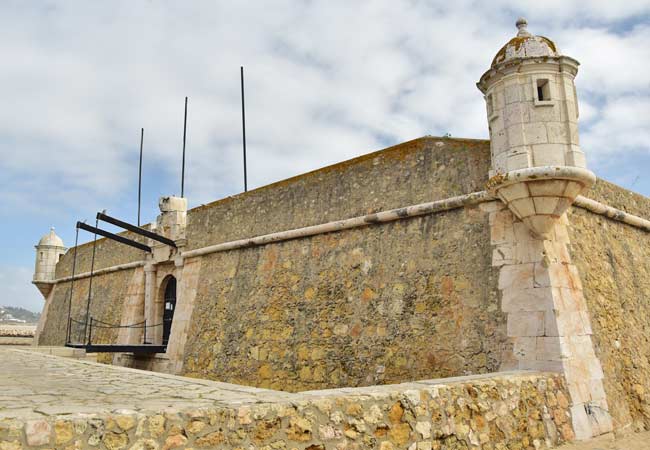
The Forte da Ponta da Bandeira
The sheltered Bensafrim estuary also shaped the city you see today. It was from this harbour that Prince Henry the Navigator established his seafaring school in the 15th century, and the explorers he inspired led voyages that would redraw the map of the known world. Walk the old town now and you are walking through the birthplace of the Age of Discovery.
What I love about modern Lagos is how lightly it carries all of this. The city has also attracted a growing community of remote workers drawn by the climate, the surf and the relaxed pace of life, and this has given Lagos a year-round creative energy. An artisan, yoga and wellness scene now sits alongside its traditional Portuguese character without displacing it, and that balance is rarer than you might think in a town this well known.
For planning your visit, it helps to know that Lagos is compact, easily walkable, and divided into four distinct areas. The historic quarter is the heart of the city, lying to the west of the Bensafrim estuary. The marina complex to the north is where you will find the modern, social side of Lagos, with its bars and restaurants lining the water. Porto de Mós is a calm, residential neighbourhood to the far south, while the long shoreline of the Meia Praia extends eastward, and this is where most of the larger hotel complexes are found.
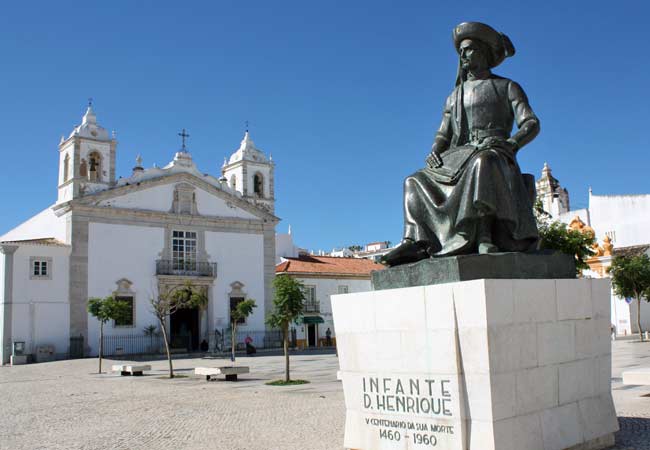
Lagos has a rich seafaring history
Lagos as a day trip
Lagos is one of the best day trip destinations in the western Algarve, and if the chance comes your way, take it. There is enough here to fill a full day comfortably, and the itinerary almost writes itself: spend the morning exploring the historic quarter, then follow the coast south to the Ponta da Piedade and its beaches for the afternoon.
Getting here is straightforward. The regional train connects Lagos to most of the towns of the central Algarve, and the station sits within easy walking distance of the old town. If you are staying within 30km but not close to a train line, an Uber or Bolt is the next best option. I use Uber regularly across the Algarve and have always found it reliable and inexpensive.
Below is a suggested walking tour of Lagos, starting from the train station. The green line and markers cover the historic centre, while the yellow line follows the coastal route out to the Ponta da Piedade headland.
Sights along the route: 1) Lagos Marina 2) Municipal market 3) Gil Eanes plaza 4) Former slave market 5) Saint António Church 6) Santa Maria church 7) city walls 8) Saint Gonçalo city gate 9) Ponta da Bandeira Fort 10) Batata beach 11) Pinhão beach 12) Dona Ana beach 13) Camilo beach 14) Ponta da Piedade 15) Discoveries waxwork museum 16) Meia Praia beach
Lagos for 2026
Lagos is expecting another busy summer in 2026, with returning visitors and a growing number of first-time arrivals who are only now discovering the western Algarve. The best accommodation books up months in advance, and the centrally located, well-reviewed hotels are always the first to go. My advice is to secure your flights and hotel as early as you can.
Use the map below to browse the best accommodation in Lagos. Adjust the dates to match your holiday and it will display current prices and live availability.
Insight: Many hotels in Lagos allow free cancellation, so you can secure a good price now and continue browsing risk-free right up until your holiday.
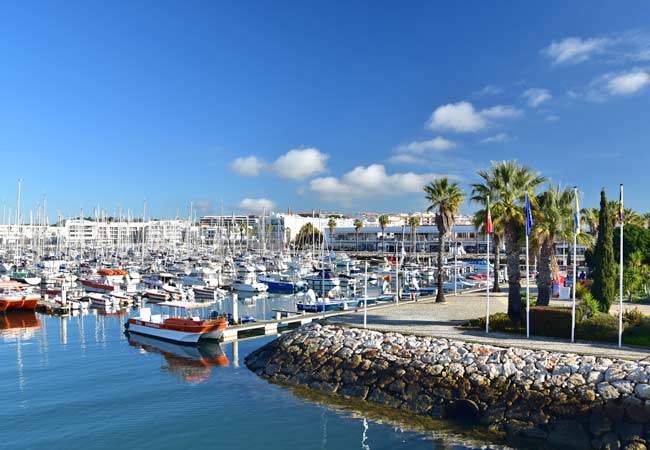
The modern marina complex of Lagos, filled with social bars and restaurants
How long should I spend in Lagos?
A single day is enough to see the main sights on the walking tour above, but in my opinion you should stay at least one night. Lagos is a city that changes character after dark, when the day-trippers have left and the marina restaurants and old-town bars come into their own, and you would be missing half the experience by heading back to your base somewhere else.
If you are touring the Algarve, plan for at least two days: the first for the city itself, the second for the beaches and the Ponta da Piedade. And if any part of your trip takes you into the western Algarve, Lagos is the place to base yourself.
For a full week, Lagos is as good a base as you will find anywhere in the region. As the largest city in the western Algarve, it has the widest selection of restaurants, bars and shops, and you could easily eat somewhere different every evening without running out of options. A week also gives you time to enjoy the beaches properly and to take day trips to Sagres, Silves, Praia da Luz and Portimão without feeling rushed.
My suggested itinerary for a one-week holiday is:
Day 1 - Explore the historic centre of Lagos
Day 2 - Boat tour of the Ponta da Piedade, followed by a relaxing beach afternoon
Day 3 - Day trip to Sagres and the Cabo de São Vicente
Day 4 - Day trip to Silves
Day 5 - Day trip to a theme park (Zoomarine) or waterpark (Slide & Splash)
Day 6 - Day trip to Portimão and Praia da Rocha
Day 7 - Day trip to Praia da Luz and Burgau (ideal for cycling)
Note: A car is not needed for this itinerary; the whole week is doable by public transport and Uber.
Related articles: 1 week in Lagos - 3 days in Lagos
Lagos for a family holiday
Lagos is one of the finest family destinations in the Algarve, and what sets it apart is the atmosphere. The city has a wide selection of family-friendly hotels, restaurants are welcoming to children, and the overall pace is noticeably more relaxed than larger resort towns such as Albufeira or Praia da Rocha. You are staying in a real Portuguese city with your family, not a purpose-built holiday complex.
The beaches are ideal for children. Golden sands, clean waters, and lifeguards on duty throughout the summer. The western end of Meia Praia and the cove beaches tucked within the Ponta da Piedade headland are naturally sheltered from the strong currents and powerful waves that affect other parts of the Algarve coast, which is a real reassurance when you have little ones splashing about.
For activities, Lagos Zoo is a lovely half-day out for younger children, while the dolphin-watching boat trips from the harbour appeal to all ages. Older children and teenagers will enjoy the Slide & Splash water park, the Zoomarine marine park, and the high rope courses at Parque Aventura. Lagos is also one of the best places in Portugal for children to take their first surf lesson, with a number of well-established surf schools running beginner sessions at Porto de Mós and Meia Praia.
These are not hollow recommendations. I brought my brother and his family to Lagos, and they had a brilliant time here. The kids had beaches, activities and endless ice creams, my brother and his wife managed a few quiet dinners out in the evenings, and I got to play the doting uncle for a week.
When to visit Lagos?
The peak season in Lagos runs from mid-July to the end of September, with beach-worthy weather reliably on offer from May through to mid-October. That gives you a generous six-month window, and the month you choose will shape your holiday more than you might expect.
July and August are the busiest months and the natural choice for families tied to the school calendar. June and September are the preferred months for visitors without school-aged children, and in my view they offer the best overall balance: warm seas, long days, and a city that feels lively without being overwhelmed. The cooler shoulder seasons of May-June and September-October are ideal for activity-based holidays such as cycling, golf, hiking and coastal walking. My personal favourite is June, when the weather is glorious, the sea has warmed up from its winter chill, and the full summer crowds have not yet arrived. A word of warning on September though: it is far busier than most people expect, so do not arrive hoping to find an empty Lagos.
The low season runs from November to Easter, and here Lagos has a distinct advantage over smaller Algarve resorts. Because the city has a large permanent population and a well-established community of remote workers, almost all the restaurants, cafés and bars stay open through the winter. Lagos should not be thought of as a winter sun destination, but between November and February the Algarve enjoys some of the mildest, sunniest weather anywhere in mainland Europe, and Lagos is one of the best places to experience it.
Related article: When to visit Lagos
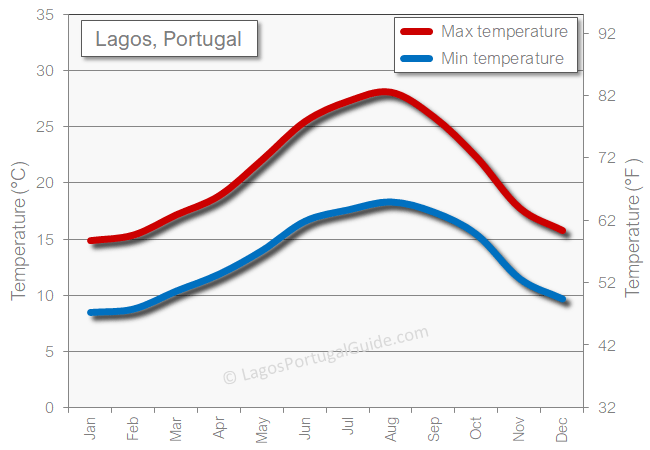
The average daytime maximum and the night-time minimum temperature for Lagos
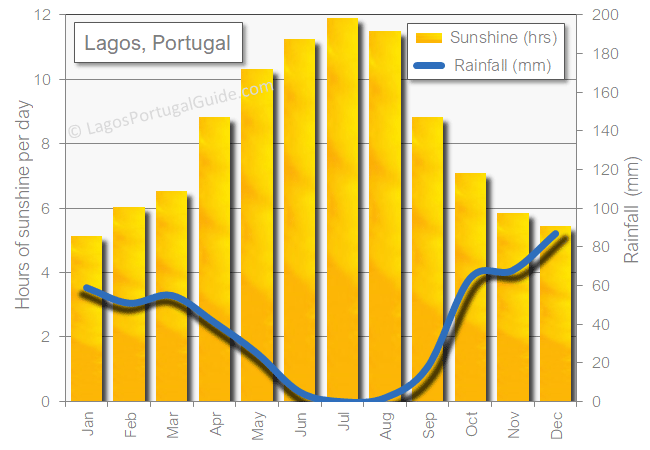
The average hours of sunshine per day and monthly rainfall (in mm)
Does Lagos have great beaches?
Lagos has some of the finest beaches in the Algarve, and this varied coastline offers something for everyone.
Extending for almost 2km to the east of the city is the Meia Praia, a vast expanse of golden sand that is perfect for relaxing and long walks. To the south, the limestone headland of the Ponta da Piedade conceals a string of sheltered cove beaches, including the Praia Dona Ana and Praia do Camilo, set at the base of golden cliffs and lapped by crystal-clear waters. These southern beaches are sheltered from the wind, waves and currents, making them ideal for families or for blustery days in the shoulder season. They do get very busy in summer, so head to the Meia Praia if you want space.
Beyond the headland, the coastline faces the open Atlantic. The beaches here, including Porto de Mós, offer powerful waves that make them popular with surfers. Porto de Mós is also a great choice if you prefer a quieter, more residential area away from the centre of town.
One thing that catches every visitor off guard is the water temperature. The sea is fed by the Atlantic and is always chilly, even at the height of summer. When I went surfing at Porto de Mós in July, I needed a full-length wetsuit. If you are visiting early in the season, be prepared for a cold shock.
Related articles: Beaches of Lagos
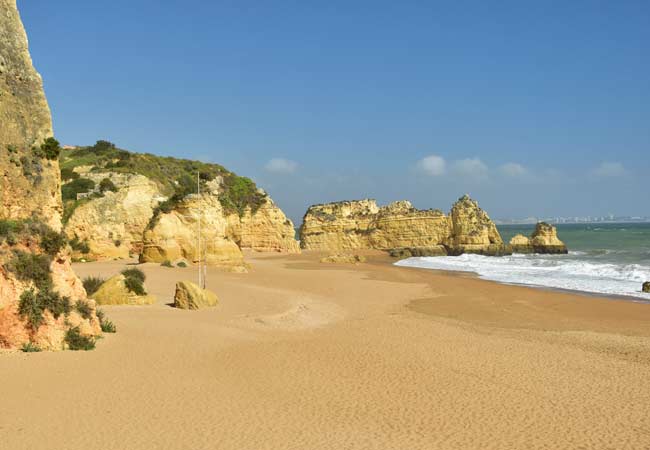
The Praia Dona Ana beach on a deserted March afternoon, but expect it to be much busier in the summer!
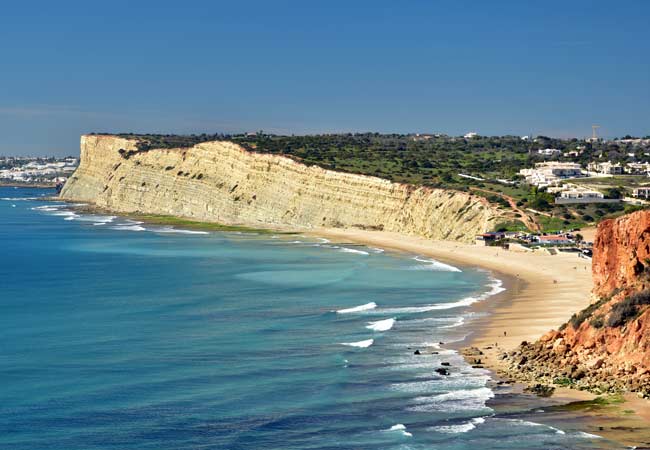
The Praia de Porto de Mós beach is ideal for surfing
What are the best day trips from Lagos?
The two best day trips from Lagos are to the historic town of Silves and the surfing town of Sagres.
Sagres lies at the western tip of mainland Europe, a region battered by ceaseless winds and mighty Atlantic seas. It is a popular surfing destination and ideal for visitors who appreciate nature's raw power.
Silves was the ancient capital of the Algarve and remnants of this illustrious past are found throughout the peaceful town. The prominent feature is the massive red brick castle, while traditional houses and shops line the cobbled streets that lead down to the river.
Alternative day trips from Lagos include the peaceful resort town of Praia da Luz, the shopping town of Portimão and the lively resort town of Praia da Rocha. All can be reached by inexpensive public transport and there is no need to hire a rental car.
Related articles: Sagres - Day trip to Silves
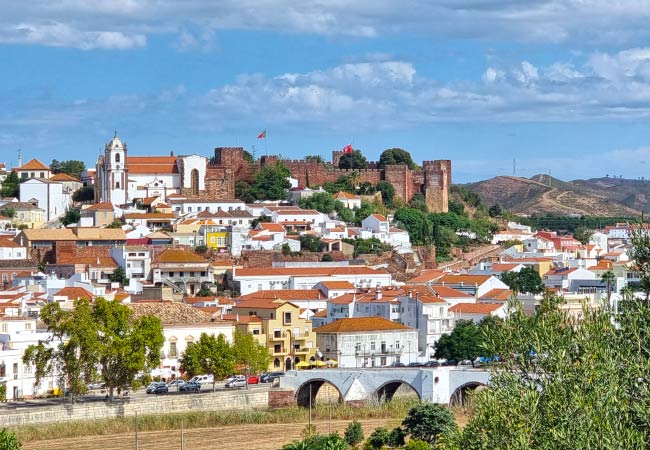
The view looking over Silves with the red brick castle standing at the highest point.
Airport transfer to Lagos
The nearest international airport to Lagos is Faro Airport, 90km to the east. The transfer is often the most expensive or time-consuming part of your trip to Portugal, so it is worth planning ahead.
Pre-booked transfer is the simplest option for this long journey. YellowFish is the company I regularly use; you book in advance, a driver meets you at arrivals, and the journey takes around an hour. This is the stress-free option, especially if you are arriving during peak season or with a family.
Uber or Bolt is what I now use when travelling outside of peak season. It is cheaper than a pre-booked transfer, but during the summer there is extremely high demand and you can be waiting a long time for a driver. Never get a regular taxi from the terminal as this will be very expensive; expect to pay over €110.
Direct bus from the airport is the cheapest option. The Route 56 Vamus Aerobus runs directly from Faro Airport to Lagos, stopping at Albufeira, Lagoa and Portimão. The journey takes around two hours and costs approximately €17. In high season there are typically five or six departures daily, but in low season this drops to just two. The bus stop is directly outside the arrivals terminal. From experience, if you miss a service the wait can be long, so check the timetable before you fly.
Train from Faro is another option but requires getting to Faro city centre first, either by local bus or Uber. The regional train connects Faro to Lagos but afternoon departures are limited. There is also an express bus (Route 57 Transrápido) from Faro bus station which runs more frequently than the Aerobus.
Whatever public transport option you choose, have a backup plan in case of delays leaving the airport. I always keep Uber as a fallback.
Related article: Faro airport to Lagos
Accommodation in Lagos
Lagos is a major city and popular holiday destination and there are over 270 different accommodation options. Some of the best options include:
Cascade Wellness Resort - Located between the Ponta da Piedade and the Porto Mós beach this clifftop 5-star hotel complex offers a tranquil atmosphere, a beautiful pool complex and high-end tourism. Premium priced but highly recommended.
Iberostar Selection - Positioned along the Meia Praia beach, this beachfront 5-star resort offers multiple pools and dining options, but is a 2.5km walk to the centre of Lagos. This is the hotel for when you want a beach-focused holiday.
Avenida Hotel - Fantastic 4-star hotel situated in the centre of Lagos, and is the place to be based if you want to be in the centre of the action. Beautiful rooftop pool and lounge area, but smaller than the out-of-town complexes.
Casa Mãe - The perfect blend of Portuguese character and 5-star refinement. Known for its outstanding service, Casa Mãe is a top choice for travellers seeking a serene and luxurious experience.
Vila Galé - The largest hotel of Lagos, positioned on the western side of the Meia Praia beach and within walking distance of central Lagos. A wide selection of amenities, and the best hotel for a family holiday.
Palmares Beach House (Adults only) - Where to head for a tranquil, child-free holiday. Beautiful setting and wonderful modern facilities but its serenity means it is located a long way from central Lagos, 4.5km away.
Atlantic Hotel - A charming smaller-sized 4-star hotel in the Porto Mós area of Lagos. Its location may not be as central as some hotels, but it makes up for this with excellent customer service and a more personable feel than larger hotels.
Villas D. Dinis (adults only) - A smaller adults-only hotel within walking distance of the Praia Dona Ana beach.
Often, the best accommodation in Portugal is found in the family-run guest houses that are managed with care by their owners. The best examples of cherished guest houses in Lagos are the delightful Villa Zawaia B&B, the Blue Moon Guest House, and Casa Creativa Lagos. As they only have a handful of rooms they often sell out.
For cheaper options there are many decent hostels, and some of our favourites include Boutique Taghostel, Olive Hostel and Orange3 Hostel.
Insight: Due to the ongoing housing issues in popular tourist areas throughout Portugal, I cannot recommend rental apartments in any residential areas of Lagos. This issue stems from investors purchasing houses and apartments for short-term rentals, which pushes up rents and makes house ownership unachievable for locals. If you are a tourist, please stay in a hotel, guest house, or hostel.
Discover more of Lagos with our most popular guides


About this guide: I am Philip Giddings. I live in Lisbon with my Portuguese wife, Carla, whose family and friends are in the Algarve, and I am down in Lagos most months to research these guides, which are now my full-time work. I made my first trip to Portugal in 2001 and have written independent guides since 2009.
My Lagos guides are part of a wider set of almost 2,000 I have written across Portugal. No tourist board, tour operator, or attraction pays to be included, and the site is funded by affiliate commissions on tour and accommodation bookings, disclosed on every page that carries them. Every practical detail (ticket prices, opening hours, bus routes, boat-tour policies) is checked against the official sources and confirmed in person on the trips I make through the year. Read my full story here.