LagosPortugalGuide.com
The best independent guide to Lagos
LagosPortugalGuide.com
The best independent guide to Lagos
Lagos weather: month by month averages and when to visit
Lagos is one of the finest towns in the Algarve, combining a fascinating historic centre with dramatic coastline, beautiful beaches and a lively atmosphere that runs well beyond the summer months. It is a proper working town with a large permanent population, which gives it a character and energy that smaller resorts simply cannot match.
The region enjoys a classic Mediterranean climate, featuring hot, dry summers and mild winters. The weather is reliably fine for heading to the beach from mid-April through to mid-October. The peak months are July and August, when the town is at full capacity, the smaller cove beaches fill up quickly, and you will need to book ahead for the popular restaurants.
For most visitors, the best months to visit Lagos are June and September. My personal favourite is May. The weather is warm and settled, the beaches are uncrowded, and the town has a wonderful atmosphere with everything open but none of the summer intensity. It is a particularly good time for exploring the coastline on foot or combining beach days with sightseeing.
Spring and autumn are particularly well suited for activity-based holidays. The dramatic coastline south of Lagos offers some of the best coastal hiking in Portugal, and there are fascinating day trips to Silves, Sagres and Portimão, which are too draining in the heat of summer.
Winter months (November through March) bring cooler conditions and occasional rainfall. Unlike smaller Algarve resorts that go very quiet, Lagos keeps a genuine year-round buzz thanks to its large local population. The majority of restaurants, cafés and shops stay open through the winter, making it one of the best options in the Algarve for an off-season break.
The Algarve has been part of my life for over 25 years, thanks to my Portuguese wife. I've experienced Lagos from the sweltering heat of August to surfing large swells on Praia do Porto de Mós in November. This guide will help you identify the ideal time for your visit, and what to expect from each season.
Related articles: Introduction to Lagos - Sights and activities
Lagos Weather Throughout the Year
Lagos enjoys the Algarve's classic Mediterranean climate, though its position on the western coastline brings a slightly stronger Atlantic influence than towns further east. The region sees over 300 days of sunshine annually, and the refreshing sea breezes that sweep along the dramatic cliffs south of town provide welcome relief during the hottest months.
Summers are hot and dry, with July and August seeing average high temperatures of 29°C (84°F) to 33°C (91°F). Official statistics never really tell the true story of what it feels like, as they measure air temperature in the shade. When you explore the Ponta da Piedade headland in the midday August sun, it will feel significantly hotter than 29°C. During these peak months, rainfall is virtually non-existent and visitors can expect around 12 hours of sunshine daily.
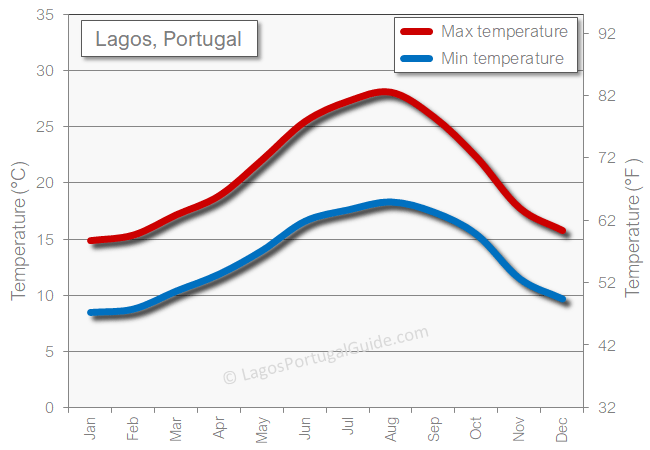
The average daytime maximum and the night-time minimum temperature for Lagos
The sea breeze provides welcome relief during summer heat waves, and evenings are rarely muggy. That said, once night sets in and the wind drops, the humidity can make it feel like the temperature has risen. In the summer you will want air conditioning, though I do not have it in my flat and it is manageable.
Spring arrives early in Lagos, with March seeing temperatures climb to 18°C (64°F) and April warming to 20°C (68°F). Early spring can still see occasional rainfall, but by May the weather has settled and brings increasingly consistent warmth, reaching around 22°C (72°F), making it ideal for exploring before the summer crowds arrive.
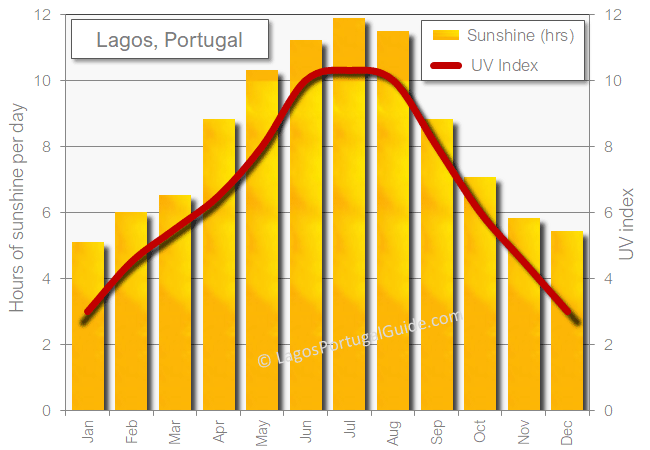
The average hours of sunshine per day
Autumn extends the summer ambience well into October. September offers particularly appealing conditions at around 27°C (81°F), with warm days and comfortable evenings. The sea is at its warmest in September and early October after months of summer sun, making it the best time for swimming and water activities at the cove beaches. By November, temperatures settle to a pleasant 18°C (64°F).
Winter in Lagos brings mild daytime temperatures of 16°C (61°F), though nights can feel chilly, dropping to around 8°C (46°F). December through February are the wettest months, with occasional heavy showers interspersed with bright, sunny periods. Despite being the wettest period of the year, the rain typically falls in short bursts rather than lasting all day, with clear skies often returning quickly.
Unlike smaller Algarve resorts, Lagos maintains a steady vitality year-round thanks to its large permanent population, making it one of the better options in the region for a winter break.
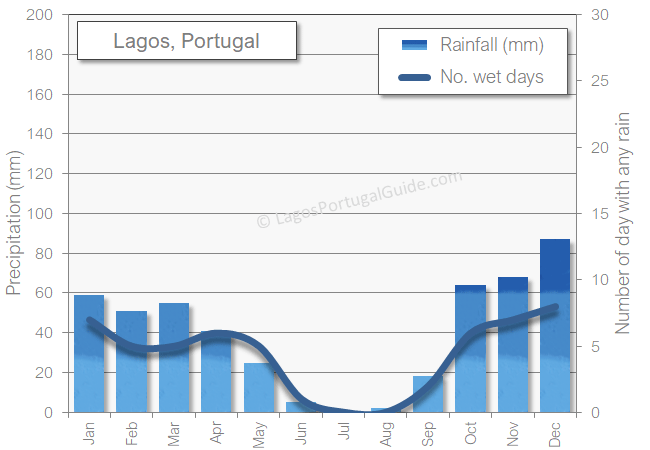
The monthly rainfall and number of wet days
How many beach days per month?
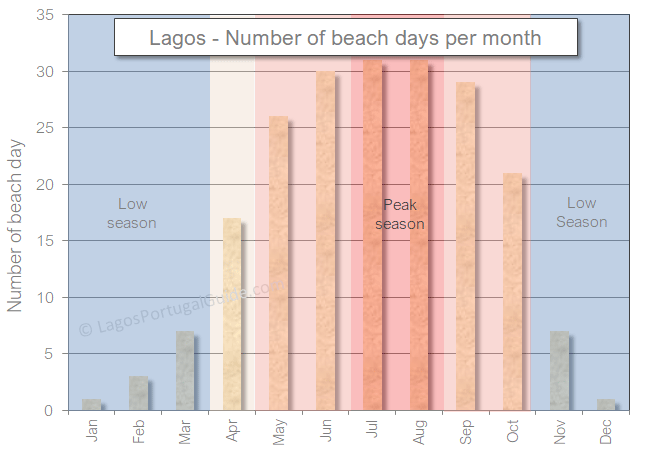
Before planning your holiday to Lagos, it's helpful to understand how beach-friendly the climate is throughout the year. Not every sunny day is a beach day. I class a "beach day" as one with at least three consecutive hours of full sunshine (minimal cloud cover) and temperatures exceeding 22°C (72°F).
Summer provides the most reliable beach weather, with nearly every day in July and August suitable for visiting the beach. In contrast, the winter months of December through February rarely qualify as beach days, with temperatures typically remaining below the 22°C threshold even on sunny days.
The following chart shows the average number of beach days for each month in Lagos.
Have You Booked Your Accommodation?
Lagos is one of the most popular towns in the Algarve, and accommodation in the historic centre fills up fast during the summer months. There is a good range of hotels, guesthouses and apartments, but the best-located properties go early. I would always recommend booking as soon as your dates are confirmed.
The map below displays hotels and accommodation in Lagos. Adjust the dates to your holiday to see current prices and availability.
Sea Temperatures in Lagos
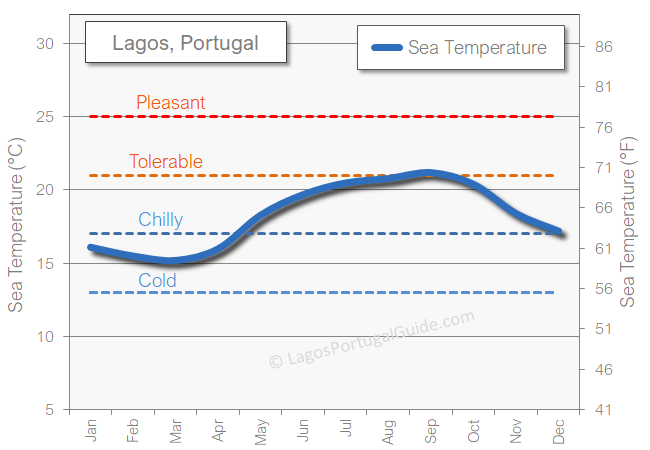
First-time visitors to Lagos are often caught out by how cold the sea is, particularly at the height of summer. The western Algarve faces the full force of the Atlantic, and the North Atlantic Current brings cooler waters southward along Portugal's coastline, making the water noticeably colder than the sheltered resorts of the eastern Algarve or the Mediterranean.
Winter months (December through March) see the coldest waters, typically ranging between 13°C (55°F) and 15°C (59°F). Spring brings gradual warming, with May reaching about 18°C (64°F).
By summer, sea temperatures reach their peak at just 21°C (70°F), creating a striking contrast with the hot air temperatures on shore. If you intend to swim in the sea for extended periods, particularly when surfing at Praia do Porto de Mós, wearing a wetsuit is recommended.
The different tourist seasons of Lagos
The tourist seasons in Lagos can be divided into four distinct periods.
Peak Season (July-August): Lagos is at its busiest. The small cove beaches south of town fill up quickly, the popular restaurants need booking in advance, and boat tours to the Ponta da Piedade grottoes should be reserved several days ahead. Accommodation prices are at their highest and the best properties sell out well in advance. The weather is consistently hot and sunny, and the town has a buzzing atmosphere in the evenings, with the bars and restaurants around the old town packed most nights.
High Season (June and September): These are my recommended months, though if pushed I would pick May. The weather is warm and settled, the cove beaches are far less crowded, and you can get a table at most restaurants without booking. Lagos still has a lively feel during these months as everything is open and running, but the pace is noticeably more relaxed than July and August.
Shoulder Season (April, May and October): The milder temperatures make this the best time for exploring the dramatic coastline south of Lagos on foot, or taking day trips to Sagres, Silves and Portimão without wilting in the heat. Beach days are still possible, particularly in May and early October, though the sea remains cold. Lagos attracts a more mature crowd during these months, along with longer-stay visitors escaping northern European winters. Accommodation prices drop significantly.
Low Season (November-March): Where Lagos differs from smaller Algarve resorts is that it keeps going through the winter. The large local population means the historic centre stays busy with cafes, restaurants and shops open year-round. It feels more like a real Portuguese town than a tourist destination during these months. The weather is mild enough for walking and sightseeing on most days, accommodation prices are at their lowest, and if you want a genuine off-season Algarve experience, Lagos is one of the best places to base yourself.
What is the wettest month for Lagos?
The wettest period in Lagos occurs during winter, with December typically being the rainiest month, followed closely by November and January. During December, Lagos receives an average of 94mm (3.7 inches) of rainfall, usually concentrated in short but sometimes heavy downpours rather than continuous rain.
Despite being the wettest time of year, I've found that these winter months still offer many clear, sunny days between rain showers. Even in December, Lagos typically experiences around 5–6 hours of sunshine daily, and I've rarely seen rain persist throughout an entire day. When compared to northern European destinations, Lagos remains relatively dry even during its wettest months, with the Algarve region receiving significantly less annual rainfall than many other European coastal areas.
When is the best time of year to visit Lagos?
In my opinion, late spring (May–June) is the best time of year to visit Lagos. Temperatures begin to rise (often ranging from 20–25°C), and days are sunny with occasional cloud cover. Rain is rare, and the offshore breeze ensures walking is comfortable.
I find this consistent weather pattern excellent for enjoying the region's offerings without the packed beaches and crowded restaurants of summer. The springtime daylight hours (9–10 hours on average) also mean I can combine beach trips with local sightseeing, water-based activities, or day trips to other Algarve highlights.
The beaches and natural sights are welcoming for sunbathing from May onwards, yet they remain uncrowded, allowing me to choose a different location each day. The moderate temperatures also make hiking, biking and coastal walks highly enjoyable.
Overall, I feel springtime offers the charm, sights and entertainment of summer without the intense heat.
When best for young families (Easter to July)
I think Lagos is an excellent Algarve destination for families in most seasons (except winter), as the resort features a vibrant atmosphere, entertainment and excellent beach amenities.
However, I find the spring weather in Lagos particularly suitable for families with young children. The climate is sunny and warm without the soaring heat of summer, which can be exhausting for younger visitors.
When I brought my sister and her young family to Lagos it was in late May and she had the perfect holiday (for a young mother!). Safe beaches for the children to play, family-friendly accommodation options and a chance to relax (while I had the fun of uncle duties).
For families with teenagers, there are excellent day trips to other popular local destinations, such as Sagres, where adolescents can take a water sports lesson. The waterparks are open from Easter onwards and are far more enjoyable without the summer queues.
When to visit for older visitors (September to October)
The autumn weather in Lagos is typically mild, and daylight hours remain relatively long (9–10 hours). This creates ideal conditions for day trips, and I think Lagos serves as a wonderful base to explore the popular Western Algarve.
I find that visitors in autumn experience a distinctly Portuguese Lagos, as locals are no longer overwhelmed by tourists. Restaurants, historical sites, and cultural attractions remain open and do not require advance planning or booking.
The beaches are also quieter but remain very comfortable for relaxation, and some of the more walkable beaches feel peaceful and secluded. Boat trips continue to run, but highlights such as the Benagil Caves are less crowded. For those interested in golf, the Algarve offers excellent courses, and the facility closest to Lagos is one I'd highly recommend.
Discover more of Lagos with our most popular guides


About this guide: I am Philip Giddings. I live in Lisbon with my Portuguese wife, Carla, whose family and friends are in the Algarve, and I am down in Lagos most months to research these guides, which are now my full-time work. I made my first trip to Portugal in 2001 and have written independent guides since 2009.
My Lagos guides are part of a wider set of almost 2,000 I have written across Portugal. No tourist board, tour operator, or attraction pays to be included, and the site is funded by affiliate commissions on tour and accommodation bookings, disclosed on every page that carries them. Every practical detail (ticket prices, opening hours, bus routes, boat-tour policies) is checked against the official sources and confirmed in person on the trips I make through the year. Read my full story here.